Have you ever encountered the problem of wanting nonsense reviews from the guests of your shared student flat, but no suitable review portal was available?
Well, I did…
What started as a side project to learn about web development evolved into a fully featured review portal including live results, administrative access, and a self-built arduino-based vending machine for handing out sweets as a reward for submitted reviews.
This article dives into the functionality and architecture of the project.




🛠️ Tech Stack Details
- Backend
- Node.js (Runtime)
- Express (API and static content)
- Postgresql (Database)
- Keycloak (Access control)
- Raspberry Pi (Local deployment)
- nginx & dnsmasq (Local domain resolution)
- Frontend
- Vue.js (Single page application)
- Tailwind CSS (Styling)
- Vending Machine
- Wemos D1 (Arduino-based microcontroller with WiFi)
🔎 Overview
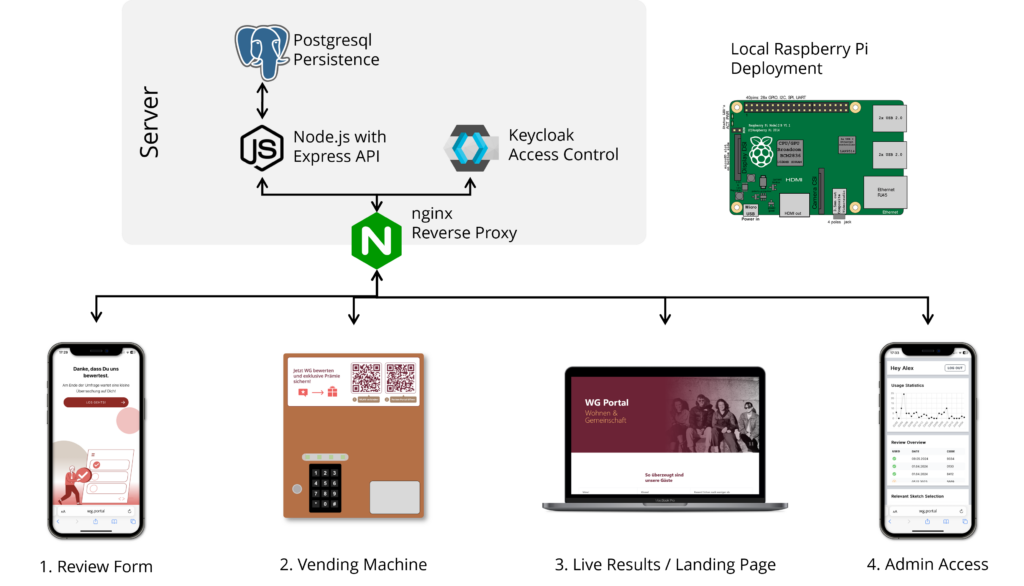
The project comprises four user-recognizable components: the review form, the vending machine, the landing page including the live review results, and the admin page. On the backend, the project is powered by an Express API running on Node.js and deployed locally on a Raspberry Pi.
📄 Review Form
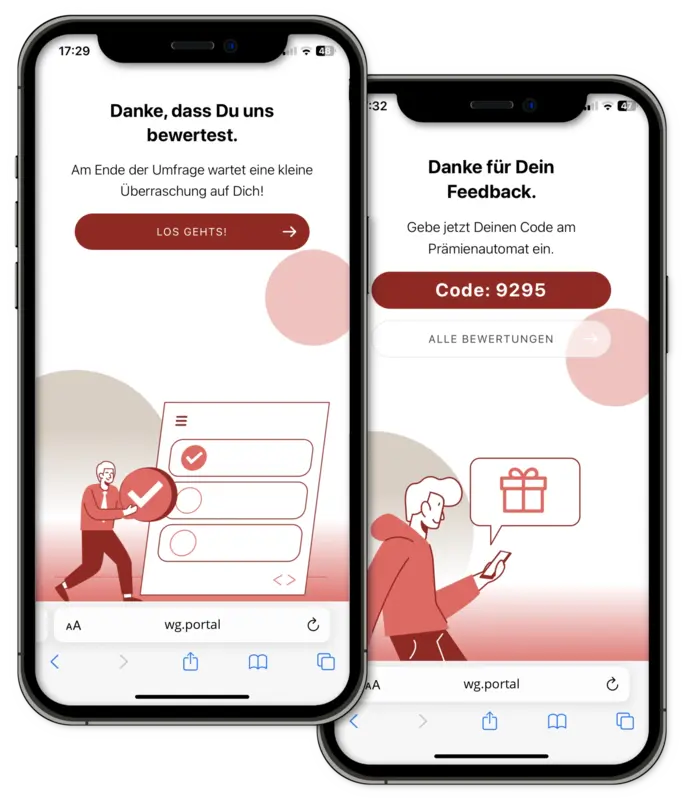
The review process is the heart of the project. In three years more than 100 people submitted their review.
The review includes a multitude of question types including single and multiple choice, textual and visual answers, textual input, conditional questions based on past answers and optional drawing.
Of course, there are hidden easter eggs. Can you spot the custom mini game? Learn more about the mini game here.
🍭 Vending Machine
It’s time to submit your review and get a reward!
The vending machine is everyone’s favorite.
Once you’ve submitted your review, you’ll receive a unique four-digit code. This code is your key to free candy from the self-built, arduino-based vending machine!
A Wemos D1 Mini is the brain of the vending machine. Once a code is entered, the microcontroller sends a request to the backend to verify that the code is legit and has not been used yet.
Putting this machine together was a lot of fun. Although the number of iterations on the dispensing mechanisms reminded me why I switched from my bachelor’s in engineering to a master’s in computer science. Let’s take a look inside.
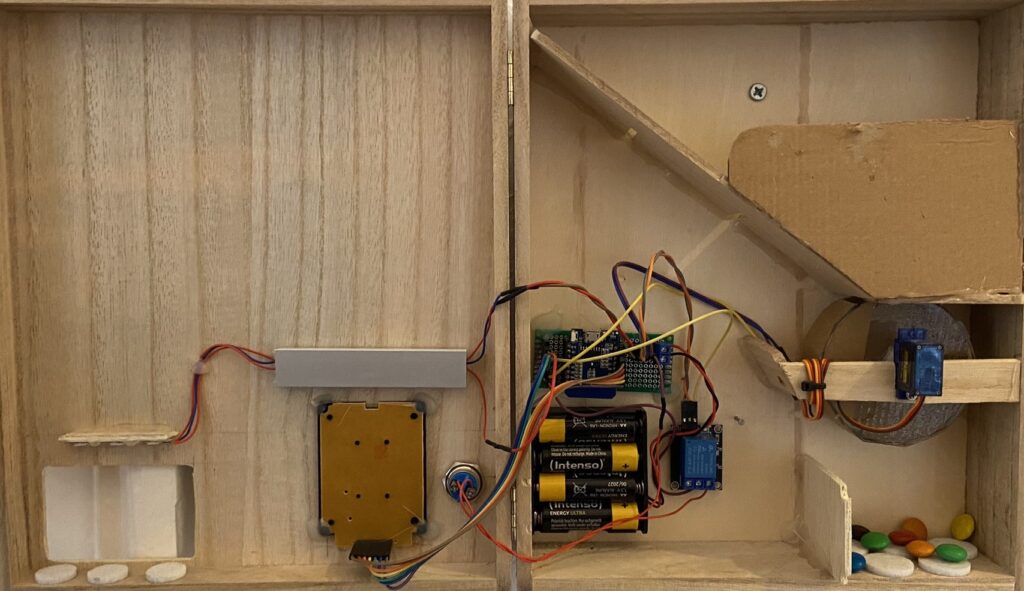
For a clean look from the outside, the machine is powered by four 1.5V batteries. In addition to the microcontroller, it includes a power button, a keypad for entering your code, a servo motor for dispensing candy, and LEDs for user feedback.
🌟 Landing Page & Results

What’s the point of collecting reviews if nobody ever sees the results?
What do our guests think of our shared flat? Do they drink beer or coffee? Are they former roommates, parents, or maybe even friends with benefits?
This page shows you all the info you need in the form of custom-made graphics based on the review data we’ve collected.
🔒 Admin Access
You might be wondering why a project like this needs an admin page. Well, I can think of three good reasons.
- One in three users closes the page and forgets their code.
- It seems that a certain motif is a particular popular choice when it comes to drawing. I wanted to be able to filter that.
- I wanted to implement an Open ID Connect Authorization Code Flow.
The authentication is implemented using the open-source SSO software Keycloak. The admin page includes statistics about the number of submitted reviews, information whether a specific code has been used yet, and filtering for textual answers and sketches.