In my master’s thesis, I had the opportunity to combine two of my passions: Software Engineering and Energy Informatics. The goal of the work was to enable researchers to examine diverse energy management and control strategies in the real-world laboratory of the Energy Lab. The result is the Building Energy Operation Platform (BEOP), an extensible microservice architecture.
In this article, I’ll be sharing the motivation behind the project and the solution I came up with. Only interested in the technical stuff? Check out the 🛠️ Tech Stack Details and skip to 🚀 How I built it.
Of all the projects in my portfolio, this project’s code is the best structured and has the highest quality. Unfortunately, the code is not publicly available. If you want private access, feel free to contact me.




🛠️ Tech Stack Details
- Python 3.8 including
- typing module
- unittest module
- Pydantic (Serialization and data validation)
- FastAPI (API and Swagger UI documentation)
- Uvicorn (Server)
- Pandas & Numpy (Time series data handling)
- MongoDB (Document-oriented database for application data)
- InfluxDB (Time series database)
- MQTT (Communication with hardware components)
- TANGO (Open Source SCADA solution)
- Docker (Containerization)
- Kubernetes (Deployment)
- GitLab CI (Continuous integration)
🤔 Why did we build it?
Current research focuses on how home energy management can address the uncertainties raised by the substantial expansion of renewable energy at the low-voltage distribution level. Examining novel energy management and control strategies (EMCS) in real-world settings is crucial, as there are limitations to simulation-based verifications. The Energy Lab’s research infrastructure, including three experimental LLEC buildings, is ideal for this purpose.
We chose to develop new software because existing energy management systems could not meet our requirements. This is due to the highly generalized infrastructure of the Energy Lab and the need to integrate multiple existing systems.
🚀 How I built it
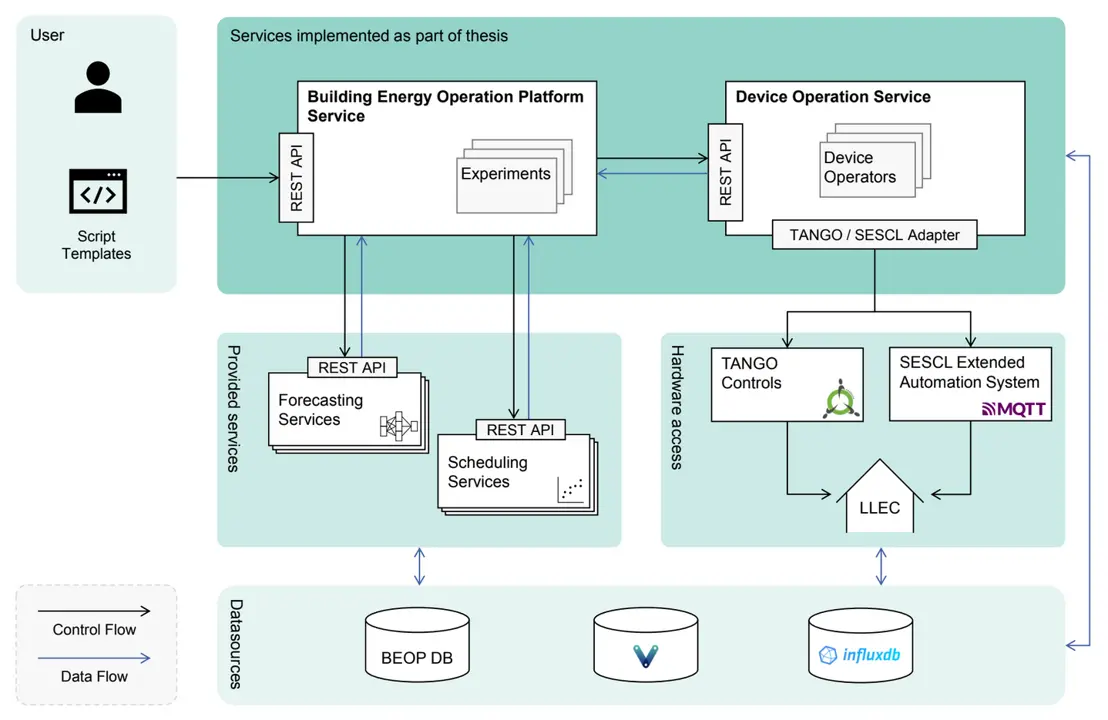
Don’t worry, I won’t bore you with the endless UML diagrams and details of my elaboration, but focus on the interesting aspects. We decided on a microservice architecture. I developed the two main services as part of my thesis. The services communicate via REST APIs and the user utilizes script templates or the SwaggerUI to interact with the main service. The system provides two mechanisms to access hardware and integrates different data sources like the institute’s InfluxDB and MQTT broker.
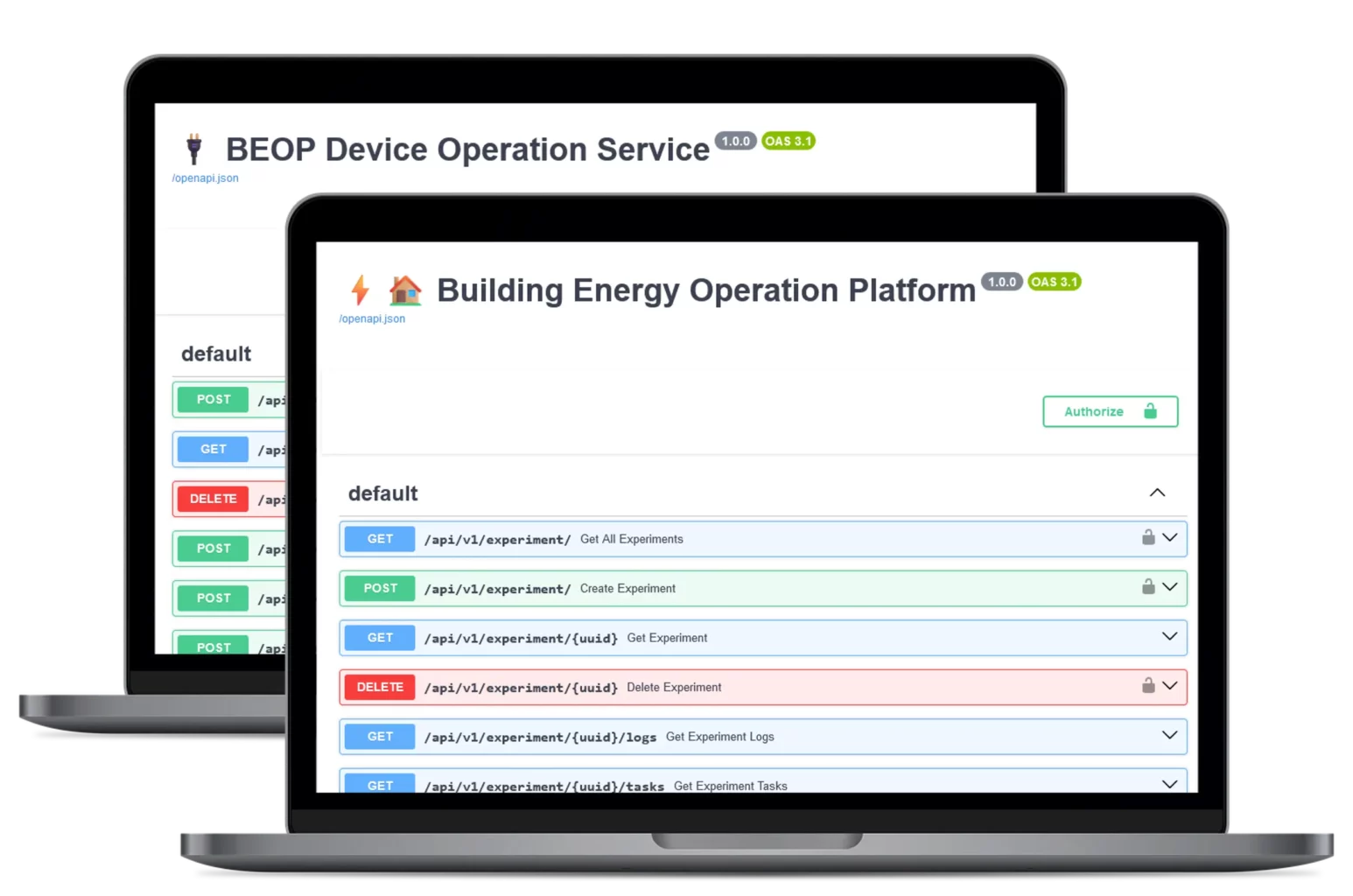
FastAPI was used for the APIs which comes with a built-in SwaggerUI integration for enhanced user experience.
Below you will find an overview of some of the software engineering methods and tools used, the motivation behind them, and an evaluation of them.
🧩 Microservices
Why? In research, requirements are constantly changing. Therefore, maintainability and extensibility were key design values. Microservices promise to achieve extensible systems.
Did it work? Yes and no. Yes, because the services could be developed independently. The ability to use the device operation, scheduling, and forecasting services individually adds value for researchers. No, because of the added complexity and performance overhead. I think in this case the advantages outweigh the disadvantages.
🛠️ Domain Driven Design
Why? We wanted to build a high quality software. Domain Driven Design provides a powerful approach to managing complexity in software development, improving communication and ensuring that the software remains maintainable in the long term.
Did it work? Yes and no. Yes, because concepts such as repositories, factories, domain events, and ubiquitous language noticeably improved the structure and quality of the system. No, because the BEOP’s focus on continuous, real-time control of process variables conflicts with the intended atomic manipulation of domain entities.
🎯 Clean Architecture
Why? As I said, maintainability was a key design value for us. Clean Architecture aims to achieve this at the structural level of the software architecture.
Did it work? Yes. Clean Architecture was a great blueprint for the individual microservices. Yet sometimes one less layer of abstraction would have been sufficient.
🐍 Python
Why? The goal for the software was to be used by many researchers at our institute. Most of these researchers are engineers, not computer scientists, and many have only learned Python as a programming language.
Did it work? Yes. I was skeptical about the language at first, but enjoyed the development. Python’s native typing module solves my aversion to loosely typed languages. The comparatively low performance is outweighed by the network latencies caused by the integration of various existing systems and the microservice architecture.